|
Metalworking Comments |
|
|
| I have
a mini-mill, the small one imported by Grizzly. I haven’t modified it yet,
except by adding a light. I’ve got an idea for another accessory, so I’ll
put that in. Somewhere in here I have a power hacksaw (no mods, yet) and an
arbor press that I’ll modify for terminal staking. |
| First:
some comments on the lathe; I used to have a Unimat lathe, and everything
on it was adjustable. Since it was designed to be a combination
mill/drill/lathe, the entire headstock was mounted to be removed, put on a
post, and oriented vertically for milling and drilling. It did all these
things, but needed constant tending. It was also a little too small for some
of my projects, and had great difficulty in turning anything larger than
about an inch and a quarter. I’d not been kind to it over the years, but the
major problem was that I could not find any belts locally. Now I know that I
can find them over the internet, but I thought it was time to move up.
There’s a Harbor Freight store near me, and while I shuddered at the fit
and finish on some of the tools, the 7 x 10 was a possibility, because it
didn’t look TOO bad! A search of several sites gave me some very good ideas
of the quality and problems with it, and I decided to take the plunge. That
it was on sale for $50.00 off, well, that didn’t hurt.
Pictures and comments are next.
|
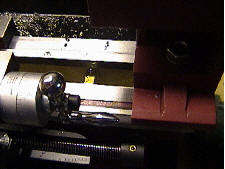 |
Does anybody else have a two
tone lathe? This one is yellow and red. |
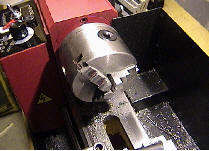 |
The 3 jaw chuck looks to be the
best piece in the whole design. Inside jaws are shown. |
|
Overall, this isn’t bad for fit and finish. It looks like some of the parts
were sand cast, because the finish seems almost rough in places. However,
the parts that need to be finished are, and that’s probably good enough.
What this isn’t, is a coherent part of an entire machine shop setup.
You can’t get all the accessories you might want, and that’s a problem. |
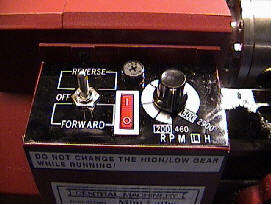 |
Plusses: Available,
got to see before I bought. Larger and more rugged than Unimat. Thread
cutting. Variable speed, minimal numbers of belts. Much more like an
industrial lathe. Minuses: Needs work on fit and finish, some adjustments
will be needed. Leaning over control panel can throw lathe into reverse.
Threading needs gear changes. Manual is rather sparse. 5/16 inch tools,
while standard, are more difficult to find. This is what you’d get if you
bought Craftsman, I think, and I’m not buying Craftsman very much at all.
Would I buy it again?
Yes, so far. It’s much better than I had, it’s worth the money. I think
that if I continue to work with metal, I’ll probably get a larger lathe, but
that’s down the road. This is portable, easy enough to lift and carry away,
and will be of good use.
So far, it’s been fun.
|
 |
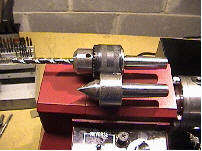 |
One of the first modifications I
did to the lathe was to cut the (not included) drill chuck’s Morse Taper to
a suitable length. I cut it to the same length as the live center. I used a
radial arm saw with an abrasive blade, and cut down by sixteenths each time.
I then ground the end to smooth it, and belt sanded a small bevel on the
edge.
|
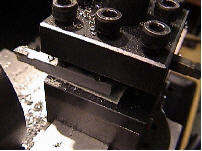 |
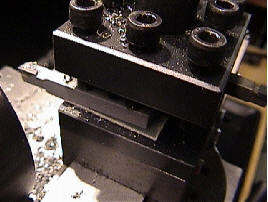
This shows the steps needed to
use a 1/4 inch tool on a lathe designed for 5/16 inch tools. I may fix this
to allow 3/8 inch tools. For that, I’ll need a 4 jaw chuck, and I think I’ll
just buy another toolpost. It’s only about 10 dollars or so. That way, I
don’t mess things up. |
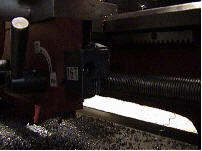 |
The thread dial arrived
vertically attached. There was not a connection between it and the lead
screw. Needless to say, the dial did not turn. Nowhere in the manual does
this get mentioned. I finally saw the connection and decided to tilt it
slightly so the gears matched. Now it works.
|